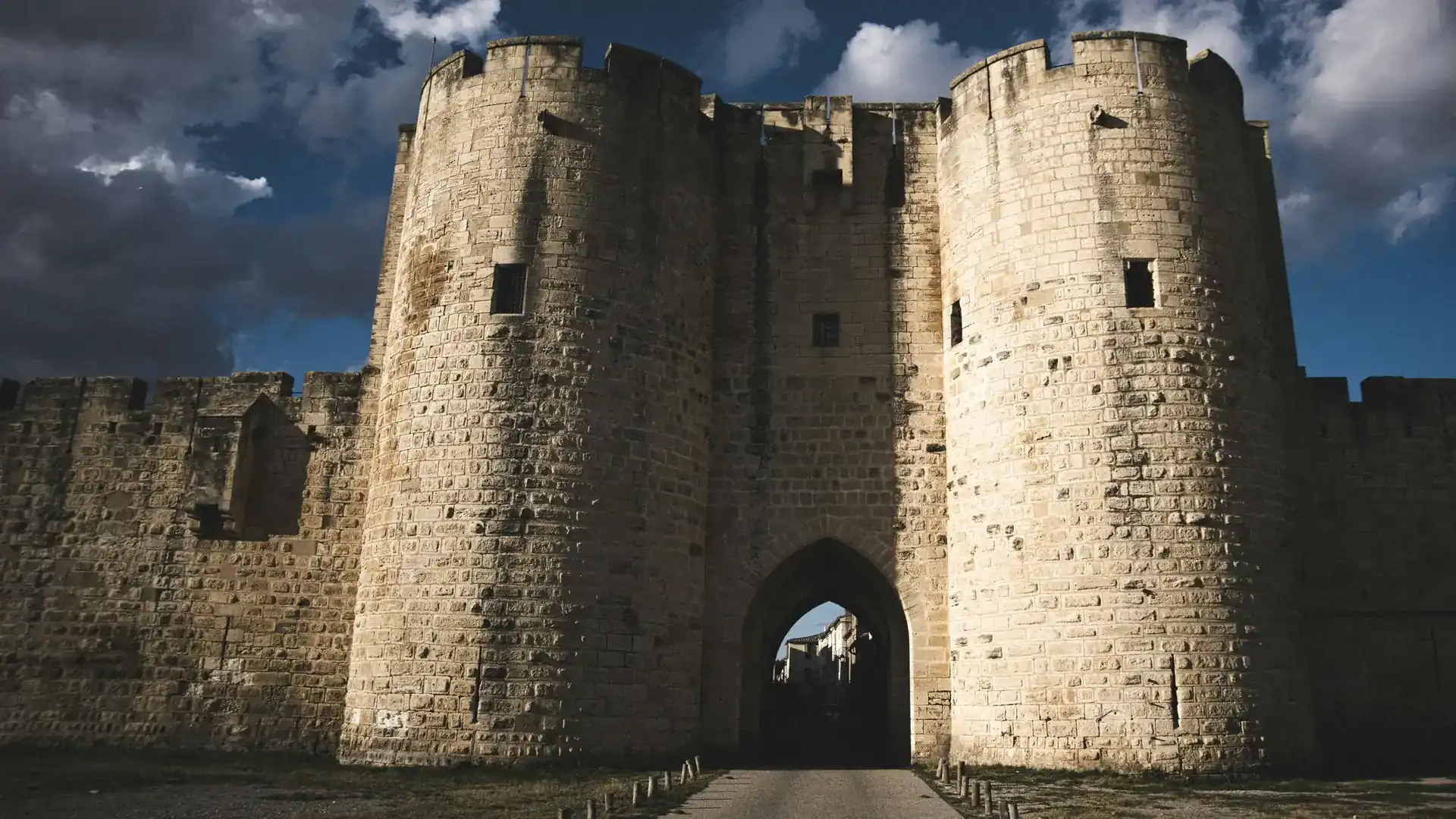
The circuit, named stop by stop
Ten gates and a series of towers punctuate the 1.6-kilometre wall. These are some of the names visitors meet — listed here as stops, not as a fixed route, since the circuit can be walked from more than one point.
- Tour de Constance
The keep beside the start
Louis IX's cylindrical keep, built 1242–1254 with walls six metres thick at the base. It stands apart from the walls, and the visit begins at the governor's lodging beside it.
- Porte de la Gardette
A gate into the grid
One of the ten fortified gates pierced through the enceinte, opening directly onto the town's thirteenth-century street grid.
- Porte de la Reine
The Queen's gate
Its name means the Queen's gate — one of the ten openings through the enceinte.
- Porte des Cordeliers
Named for the friars
Cordeliers is the old French name for the Franciscan friars, and this gate carries it.
- Tour de Villeneuve
A tower along the walk
One of the towers set along the wall circuit, away from the free-standing Tour de Constance.
The rampart walk crosses historic stairs and uneven stone, and pushchairs are left at reception rather than taken on the visit; last admission is 45 minutes before closing.

Salt and stone
A port built for the crusades
Louis IX, later canonised as Saint Louis, obtained the marshland at Aigues-Mortes in 1240 by an exchange of lands with the monks of a local abbey, so the French crown could reach the Mediterranean from its own territory. He sailed from here for the Seventh Crusade in 1248 and the Eighth in 1270, the crusade on which he died at Tunis.
Walls that still close the circle
In 1272 Philip III ordered the walls continued until they enclosed the little town completely, and the work took roughly another thirty years. The result still stands as a full circuit of about 1.6 kilometres, so the town remains entirely inside its medieval walls.
The Tour de Constance, keep then prison
Louis IX's own keep, built 1242–1254 with walls six metres thick at the base, stands apart from the wall circuit and is reached today by a bridge from the governor's lodging. After the revocation of the Edict of Nantes in 1685 it became a prison for Protestant women; Marie Durand was held there for thirty-eight years, and the word REGISTER — 'resist' — is carved into the rim of the tower's well.
A grid town still inside its own walls
Inside the ramparts the streets still follow the strict grid laid out for Louis IX's new port, centred on Place Saint-Louis and the church of Notre-Dame-des-Sablons. Outside them, the land simply stops being town and starts being the Camargue: the geometric salt pans of the Salins du Midi, and the marshes where the region's flamingos, bulls and white horses live.
Guides to the walk
The circuit
Walking the ramparts of Aigues-Mortes
The full 1.6 km circuit of medieval walls — the route, the gates and towers, and the views on both sides.
Open this guide →Seasons and light
The best time to visit Aigues-Mortes
Why spring and autumn suit the ramparts best, and when the light on the stone is at its warmest.
Open this guide →Family visits
Visiting Aigues-Mortes with kids
Why a real castle keep and a self-paced wall walk work well for families, and what to plan for.
Open this guide →Getting there
How to get to Aigues-Mortes from Nîmes and Montpellier
The direct train from Nîmes, driving routes from both cities, and where to park.
Open this guide →Highlights
What to see in Aigues-Mortes
The Tour de Constance, the rampart circuit, the grid-planned town and the Camargue setting.
Open this guide →The keep's two histories
The Tour de Constance and Marie Durand
How Louis IX's crusader keep became a prison, and the thirty-eight years linked to one word on its well.
Open this guide →What people ask before they visit
Is this the monument's own website?
No. This is an independent guide. The towers and ramparts are managed by Centre des monuments nationaux, and the monument's own website is here. We link out to Viator for booking and earn a commission on completed bookings, never added to what you pay.
How long is the Aigues-Mortes ramparts walk?
The circuit is about 1.6 km. With the climb of the Tour de Constance and stops at the gates and towers, plan on a couple of hours rather than a quick loop.
Is the visit guided or self-paced?
Self-paced: you move through the Tour de Constance and along the ramparts at your own speed. The fixed point given by the monument is last admission, 45 minutes before closing.
Who built Aigues-Mortes, and why?
King Louis IX founded it in 1240 to give the French crown a Mediterranean port of its own, independent of foreign harbours. He sailed from here for the Seventh Crusade in 1248 and the Eighth in 1270.
Who was Marie Durand?
A Protestant woman held in the Tour de Constance for thirty-eight years, from 1730 to 1768, for refusing to renounce her faith. The word REGISTER — 'resist' — carved into the rim of the tower's well is associated with her.
How many gates does the circuit have?
Ten gates pierce the four-sided enceinte, with towers set along the walls between them; the Tour de Constance stands apart from the circuit, linked to it today by a bridge.
How do I get to Aigues-Mortes from Nîmes or Montpellier?
From Nîmes, the regional TER liO train runs directly to Aigues-Mortes, whose station is about 450 metres from the walls. From Montpellier there's no direct train, so rail travellers usually change at Nîmes; by car Aigues-Mortes is about 33 km south-west of Nîmes via the A9, and under an hour from Montpellier.
Aigues-Mortes walking tours and entry on Viator
Tours and entry are listed and sold by Viator, not by this page.
Check availability on Viator